Turmeric
Turmeric in Nervecept: 50 mg of Root, Curcumin Absorption and Safety
Turmeric in Nervecept is 50 mg of Curcuma longa root per capsule, line four of eight and 7.2% of the 699 mg of actives. Arthritis trials used about 1,000 mg of curcumin a day, and curcumin is poorly absorbed. Nerve findings exist only in rats and mice. Rare liver injury and bleeding risk are the main cautions.
Written by the Nervecept label deskUpdated
The basics01
What is turmeric root (Curcuma longa)?
Turmeric is the bright orange root of Curcuma longa, a plant in the ginger family. Dried and ground, it is the spice that colors curry and yellow mustard.
Its best-known compound is curcumin, which gives the root its color. Curcumin is only a small part of the root by weight. Most turmeric research uses curcumin extracts, not plain ground root.
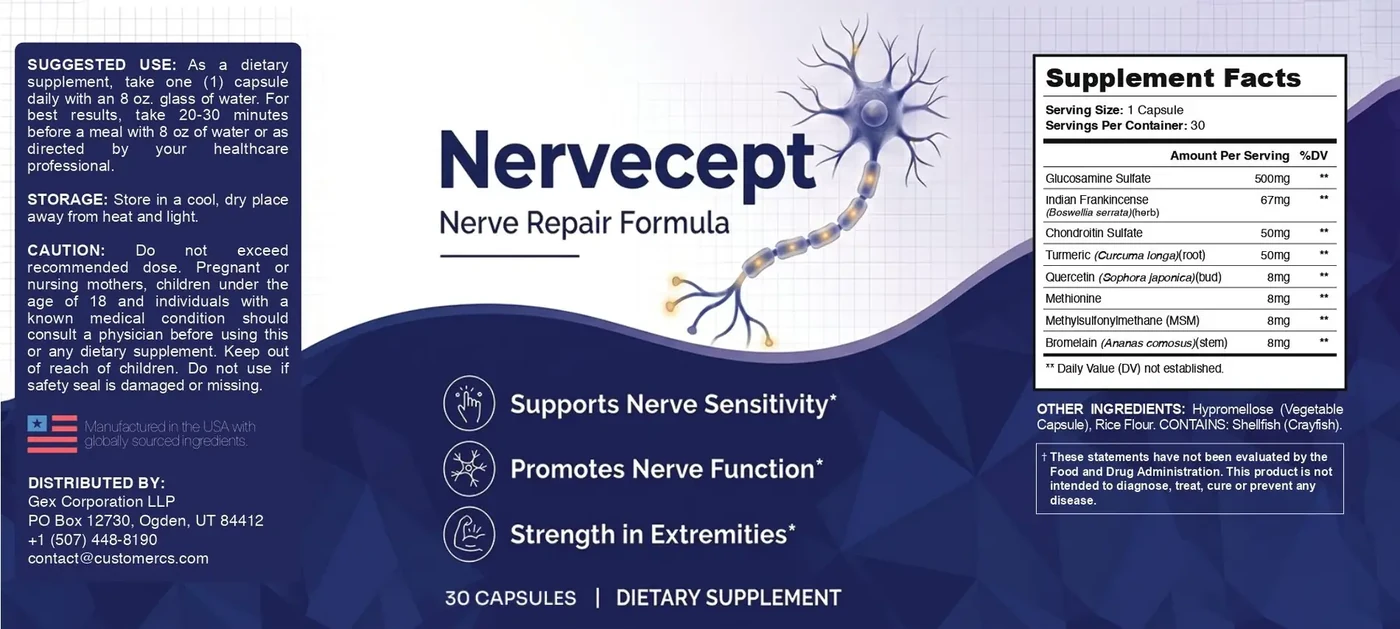
The Nervecept label prints "Turmeric (Curcuma longa)(root)". It does not list a curcumin percentage or say the root is an extract, so the 50 mg reads as root powder.
On the label02
How much turmeric is in one Nervecept capsule?
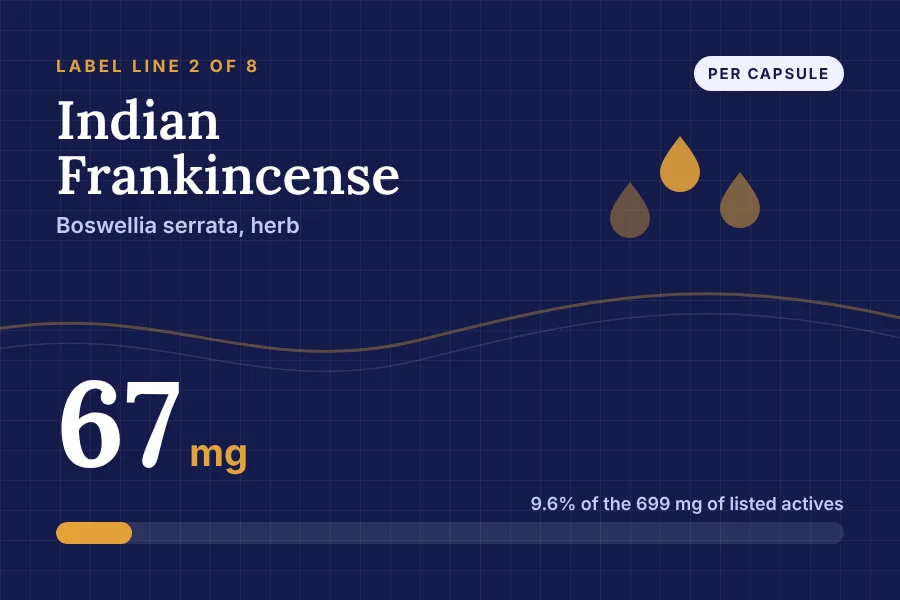
One Nervecept capsule lists 50 mg of turmeric root. It is line four on the Supplement Facts panel and 7.2% of the 699 mg of actives, the same weight as chondroitin.
For a kitchen comparison, a level teaspoon of ground turmeric weighs a few grams. One capsule holds a small pinch of that, and a full bottle adds up to 1.5 grams over a month.
| Name on the label | Turmeric (Curcuma longa)(root) |
|---|---|
| What it is | Curcuma longa root |
| Place on the label | Line 4 of 8 on the Supplement Facts panel |
| Amount per capsule | 50 mg per capsule |
| Share of the 699 mg of actives | 7.2% |
| Amount used in research | About 1,000 mg a day of curcumin (arthritis trials) |
| Strength of evidence | Weak and mixed; nerve data only in animals |
| Marketed or traditional use | Kitchen spice and traditional remedy |
| Main caution | Rare liver injury reports; caution with blood thinners and gallbladder problems. |
Research03
Does turmeric help arthritis pain?
Possibly, but the evidence is thin. NCCIH says there is not enough evidence to conclude turmeric or curcumin helps any health purpose, though arthritis analyses lean positive and need better trials (NCCIH, Turmeric).
A 2016 analysis pooled eight small arthritis trials. Turmeric or curcumin lowered pain scores compared with placebo, at about 1,000 mg of curcumin a day. The authors called the evidence too weak for firm conclusions (J Med Food, turmeric meta-analysis 2016).
MSKCC adds that most support comes from lab and animal work, and human results are mixed (MSKCC, Turmeric).
| Evidence | Dose or model | Finding |
|---|---|---|
| Arthritis trials (J Med Food, turmeric meta-analysis 2016) | About 1,000 mg curcumin a day | Lower pain scores; few, small trials |
| NCCIH summary (NCCIH, Turmeric) | Turmeric and curcumin | Not enough evidence for any use |
| Nerve review (Silveira et al., turmeric animal review) | 30 studies in rats and mice | Better nerve measures in animals; no human trials |
Dose and absorption04
Is 50 mg of turmeric enough, and is curcumin absorbed?
No on the first count, and poorly on the second. Even if all 50 mg were curcumin, it would be one twentieth of the 1,000 mg used in arthritis trials (J Med Food, turmeric meta-analysis 2016). As root powder, it holds far less curcumin than that.
Curcumin is also poorly absorbed from the gut, so only a small amount reaches the blood (MSKCC, Turmeric). That is why some products add black pepper extract or use special forms. The Nervecept label lists neither.
The usual two cautions still hold. A small dose does not prove there is no effect, and a trial-sized dose would not prove a nerve benefit in people.
Label amount
50 mg of turmeric root, not a curcumin extract.
Curcumin inside
A small fraction of that 50 mg; no percentage printed.
Absorbed
Less again, since curcumin passes the gut poorly.
Nerve evidence05
Does turmeric help neuropathy?
Not in people, as far as studies show. A systematic review found 30 studies in which turmeric compounds improved nerve measures, but every one was in rats or mice (Silveira et al., turmeric animal review).
Those animals had diabetic, sciatic, chemotherapy or alcohol nerve damage made in a lab. The authors said human trials are still needed. Animal work cannot show that 50 mg of root helps human nerves.
The FTC says health claims need human trial evidence, and animal studies alone are not enough (FTC, Health Products Compliance). Before adding turmeric to a nerve medicine plan, see the supplements and nerve medicines guide.

Nervecept: from $49 a bottle30 capsules · 2, 3 or 6 bottles · free US shipping on 3 or 6 · 60-day guarantee
See packsSafety06
Can turmeric supplements harm the liver or cause bleeding?
Yes, in rare cases. NCCIH reports liver damage in some people using turmeric products, especially highly absorbed curcumin, and MSKCC says turmeric may raise bleeding risk (NCCIH, Turmeric) (MSKCC, Turmeric).
Stop and call your doctor if you notice tiredness that will not lift, nausea, dark urine or yellowing skin or eyes (NCCIH, Turmeric). Those are signs of liver trouble.
MSKCC advises against turmeric supplements for people on warfarin or other blood thinners. It also asks people prone to kidney stones to check with a doctor first (MSKCC, Turmeric). Keep taking prescribed medicine; do not swap it for a supplement.
Fatigue, nausea, dark urine or yellow skin after starting any turmeric product: stop it and contact a provider the same day.
Who should skip it07
Who should not take turmeric supplements?
Skip turmeric supplements if you are pregnant, take a blood thinner without your doctor's approval, or have had liver problems. NCCIH says turmeric supplements may be unsafe in pregnancy (NCCIH, Turmeric).
Turmeric as a cooking spice is a different matter from a daily capsule. For Nervecept, the shellfish rule comes first: its glucosamine is made from crayfish, so anyone with a shellfish allergy should skip the capsule.
Pregnancy
Supplement doses may be unsafe; the label also asks nursing mothers to see a physician.
Blood thinners
Warfarin and similar drugs: MSKCC advises against turmeric supplements.
Liver or kidney stones
Rare liver injury reports; stone formers should check first.
Every caution for the full capsule is on the side effects page.
In the formula08
What role does turmeric play in Nervecept?
Turmeric is one of Nervecept's two main plant lines, alongside Boswellia serrata. Both are traditional anti-inflammatory plants often found in joint formulas.
At 50 mg of root, it is closer to a seasoning than a studied curcumin dose. Compare it with its plant partner on the boswellia page, or see all eight lines on the ingredients page.
FAQ09
Nervecept questions people ask
How much curcumin is in Nervecept's turmeric?
The label does not say. It lists 50 mg of turmeric root with no curcumin percentage. Curcumin is a small part of the root, so one capsule holds well under 50 mg of it.
Does Nervecept add black pepper to help absorb curcumin?
No. The label lists no black pepper or piperine and no special curcumin form. Curcumin on its own is poorly absorbed from the gut, so little of it reaches the blood.
Is turmeric in a capsule different from turmeric in food?
The plant is the same, but supplements give a daily, steady amount, and some forms absorb far better. NCCIH's liver injury reports mostly involve supplements, especially highly absorbed curcumin, not cooking.
Can turmeric affect the liver?
In rare cases, yes. Liver damage has been reported with turmeric products. Stop and contact a provider if you notice lasting fatigue, nausea, dark urine or yellow skin or eyes.
Should I avoid turmeric if I take warfarin?
MSKCC advises people on warfarin or other blood thinners not to take turmeric supplements, because turmeric may raise bleeding risk. Talk to your prescriber before using Nervecept.
Has turmeric been tested for nerve pain in people?
Not in the review we cite. All 30 studies that found better nerve measures used rats or mice, and the authors said human trials are still needed.
Who wrote this10
Written and reviewed by
Pages built from the label, the sales page and linked NIH, FDA, CDC, FTC and peer-reviewed sources.
Last updated . Read our editorial standards and how we check reviews. This website is run by a Nervecept licensed U.S. outlet, not by the manufacturer or the distributor. We earn money when you buy through our order links.
Keep reading
More about Nervecept

Nervecept licensed U.S. outlet
Ready to try Nervecept?
Check the shellfish allergen and your medicines first, then pick a pack. Three or six bottles ship free in the US and cost less per bottle, with a 60-day money-back guarantee.
- Secure checkout on the sales page
- 60-day money-back guarantee
- Ships from the U.S.