MSM
MSM in Nervecept: Why 8 mg of Methylsulfonylmethane Is a Tiny Share of Studied Doses
MSM (methylsulfonylmethane) is a simple sulfur compound sold mainly for joint and muscle comfort. Nervecept lists 8 mg per capsule. MSM is Generally Recognized As Safe, and studies have used gram-level doses, with up to 4 grams a day well tolerated. The capsule's 8 mg is about 0.2% of that. No study has tested MSM for nerves at any dose.
Written by the Nervecept label deskUpdated
The basics01
What is MSM?
MSM, short for methylsulfonylmethane, is a small organic molecule made of carbon, hydrogen, oxygen and sulfur. Chemists also call it dimethyl sulfone. It is a white, odorless powder that dissolves easily in water.
Trace amounts occur in nature, in milk, coffee, tea and some fruits and vegetables. The amounts in food are tiny, and supplement MSM is usually made in a factory rather than extracted from plants.
MSM is chemically close to DMSO (dimethyl sulfoxide), a solvent once popular as a rub for sore joints. The body converts part of any DMSO it absorbs into MSM.
A 2017 review describes MSM as studied mainly as an anti-inflammatory for joint and muscle pain (Butawan et al., MSM review 2017). That joint focus explains why it often appears next to glucosamine and chondroitin, as it does in Nervecept.
Label line 702
How much MSM does a Nervecept capsule contain?
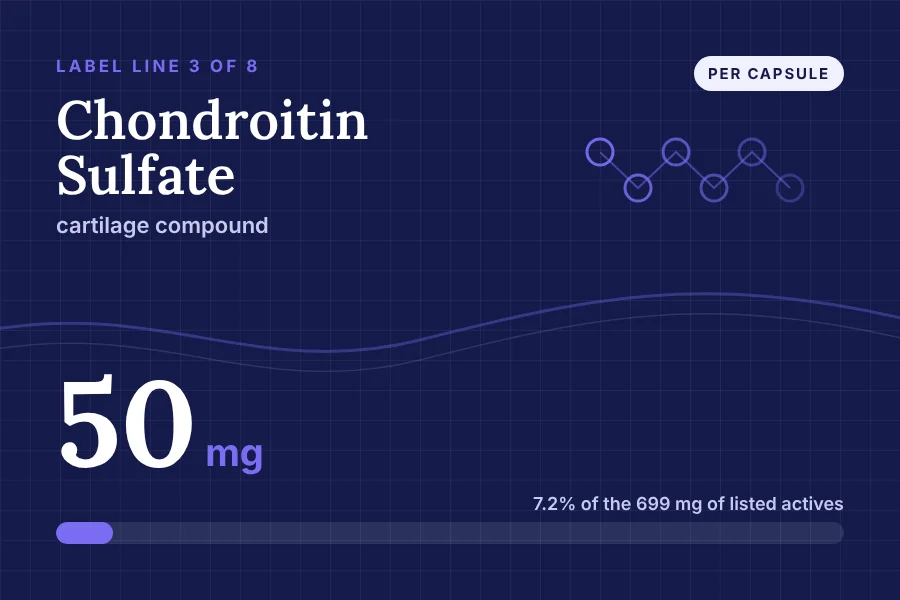
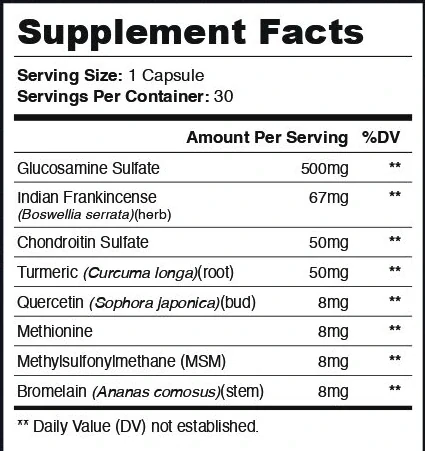
A Nervecept capsule contains 8 mg of MSM, printed as "Methylsulfonylmethane (MSM)". It is line 7 of 8 on the Supplement Facts panel and makes up about 1.1% of the capsule's 699 mg of actives.
MSM is one of four lines in the capsule that carry sulfur in some form. The others are glucosamine sulfate, chondroitin sulfate and the amino acid methionine. Of those four, MSM is the smallest by weight, tied with methionine.
| Name on the label | Methylsulfonylmethane (MSM) |
|---|---|
| What it is | Sulfur compound |
| Place on the label | Line 7 of 8 on the Supplement Facts panel |
| Amount per capsule | 8 mg per capsule |
| Share of the 699 mg of actives | 1.1% |
| Amount used in research | Well tolerated up to 4 g a day (joint and muscle studies) |
| Strength of evidence | Small joint studies; no nerve trials found |
| Marketed or traditional use | Sold for joints |
| Main caution | Mild stomach upset at gram doses; 8 mg is far below that. |
Research03
What does research show about MSM?
Research on MSM is small and focused on joints and exercise soreness. The 2017 review found it is well tolerated and has some anti-inflammatory signals, but the authors say more work is needed to settle the right dose and length of use (Butawan et al., MSM review 2017).
The U.S. National Center for Complementary and Integrative Health is more direct. In its summary of supplements for chronic pain, it rates the evidence for MSM as insufficient to judge, while guidelines recommend against glucosamine and chondroitin for hip and knee arthritis (NCCIH, Chronic Pain and Complementary).
So the honest summary is "early and limited". MSM is not a proven pain treatment, and it has not been studied as a nerve treatment.
- Main study area: knee arthritis and post-exercise muscle soreness.
- Typical study doses: gram amounts, with up to 4 g a day well tolerated (Butawan et al., MSM review 2017).
- Expert summary: evidence insufficient for chronic pain (NCCIH, Chronic Pain and Complementary).
- Human nerve trials: none that we found.
Dose math04
How does 8 mg of MSM compare with studied doses?
8 mg of MSM is about one five-hundredth of the 4 grams a day that studies found well tolerated. In other words, it would take 500 Nervecept capsules to reach 4 grams, and the label allows one a day.
Even a 1 gram dose, at the low end of gram-level research, equals 125 capsules. That gap is too large to bridge, and it should not be: the label says not to exceed one capsule.
Two cautions keep the math fair. A small dose does not prove MSM does nothing at 8 mg; there is simply no study at that amount. And a 4 gram dose would still not show a nerve benefit, because the trials measured joints and muscles.
| Amount | Where it comes from | Nervecept capsules needed |
|---|---|---|
| 8 mg | One Nervecept capsule (label) | 1 |
| 1,000 mg (1 g) | Low end of gram-level research | 125 |
| 4,000 mg (4 g) | Upper level described as well tolerated (Butawan et al., MSM review 2017) | 500 |
| Any dose for nerves | Not published | No benchmark exists |
Nerve evidence05
Is MSM good for nerve pain?
There is no human evidence that MSM is good for nerve pain. The research looked at joints and sore muscles, and NCCIH does not list MSM, or any supplement, as effective for peripheral neuropathy (NCCIH, Chronic Pain and Complementary).
Joint pain and nerve pain feel different and have different causes. Arthritis pain usually comes from worn cartilage and an inflamed joint. Nerve pain often burns, tingles or feels like pins and needles, and it is frequently worse at night (NIDDK, Peripheral Neuropathy). A compound that might ease one is not automatically useful for the other.
If you have burning or numb feet, the useful first step is finding out why. Diabetes is the leading cause of peripheral neuropathy, but there are many others (NINDS, Peripheral Neuropathy). Read more about how the formula is meant to work on the how it works page.

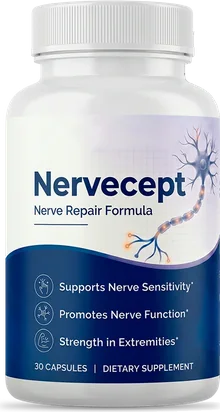
Nervecept: from $49 a bottle30 capsules · 2, 3 or 6 bottles · free US shipping on 3 or 6 · 60-day guarantee
See packsSafety06
Is MSM safe, and does it matter if I have a sulfa allergy?
MSM is Generally Recognized As Safe, and the side effects reported at gram doses were few and mild (Butawan et al., MSM review 2017). At 8 mg, the amount in Nervecept is a small fraction of the doses where those effects were studied.
A sulfa allergy is a separate question. "Sulfa" usually means a reaction to sulfonamide drugs, such as some antibiotics. MSM is not a sulfonamide, and sulfur itself is in every person's body. Still, if your allergy history is unclear, ask the clinician who recorded it.
The bigger allergy point for Nervecept is shellfish. The glucosamine is made from crayfish shells, and the label says "CONTAINS: Shellfish (Crayfish)." People with a shellfish allergy should skip the capsule (FDA, Food Allergies). More on the allergen page.
| Term | What it means | Relevant to Nervecept? |
|---|---|---|
| Sulfa allergy | Reaction to sulfonamide drugs | MSM is not a sulfonamide; ask if unsure |
| Sulfite sensitivity | Reaction to sulfite preservatives in wine and dried fruit | No sulfites are listed on the label |
| Shellfish allergy | Reaction to crustacean or mollusk proteins | Yes: the label declares crayfish |
Do not stop or reduce a prescribed pain, arthritis or nerve medicine because you started MSM or any supplement. Talk with your prescriber first.
Who should ask first07
Who should not take a capsule with MSM?
The MSM line itself rules out very few people. The Nervecept capsule as a whole is a different matter, and the groups below should skip it or ask a clinician first.
- Anyone with a shellfish allergy: skip it.
- People on warfarin or another blood thinner: other lines in the capsule carry bleeding and INR cautions (MSKCC, Glucosamine).
- Pregnant or nursing women and anyone under 18: the label asks for a physician's advice first; MSM has not been well studied in pregnancy.
- Anyone with a scheduled surgery: list every supplement for the surgical team (NCCIH, Using Supplements Wisely).
The whole capsule08
Why is MSM in Nervecept?
MSM is in Nervecept most likely because it is a familiar partner for glucosamine and chondroitin in joint formulas. The label does not state a reason, and it makes no claim for MSM on its own.
At 8 mg, it is a small supporting line. People who want to try MSM for sore joints usually buy it as a separate powder or capsule in gram amounts, ideally after talking with their doctor. For the capsule's bigger lines, see the chondroitin page and the ingredient overview.
FAQ09
Nervecept questions people ask
How many Nervecept capsules would equal a 4 gram MSM dose?
Five hundred. Each capsule lists 8 mg of MSM, and 4,000 divided by 8 is 500. The label allows one capsule a day, so Nervecept is not a way to get research-level MSM.
Is MSM the same as DMSO?
No, but they are related. DMSO is dimethyl sulfoxide, a solvent; MSM is dimethyl sulfone, and the body turns some DMSO into MSM. Nervecept lists MSM, not DMSO.
Does the MSM in Nervecept come from food?
The label does not say. Small traces of MSM occur in milk, coffee and some vegetables, but supplement MSM is usually made in a factory. The panel prints only the name and 8 mg.
Can I take Nervecept if I already take an MSM supplement?
The 8 mg would add very little to a gram-level MSM product. The bigger questions are the other lines: shellfish-based glucosamine and the blood-thinner cautions. Show both labels to your pharmacist.
Is MSM a sulfur supplement for nerves?
MSM does contain sulfur, but no human study shows it helps nerves. NCCIH rates the evidence for MSM in chronic pain as insufficient (NCCIH, Chronic Pain and Complementary), and it lists no supplement as effective for neuropathy.
Does MSM cause side effects at the Nervecept dose?
None are known at 8 mg. The 2017 review found side effects were few and mild even at gram doses (Butawan et al., MSM review 2017). If you notice anything unusual after starting the capsule, stop it and call your doctor.
Who wrote this10
Written and reviewed by
Pages built from the label, the sales page and linked NIH, FDA, CDC, FTC and peer-reviewed sources.
Last updated . Read our editorial standards and how we check reviews. This website is run by a Nervecept licensed U.S. outlet, not by the manufacturer or the distributor. We earn money when you buy through our order links.
Keep reading
More about Nervecept

Nervecept licensed U.S. outlet
Ready to try Nervecept?
Check the shellfish allergen and your medicines first, then pick a pack. Three or six bottles ship free in the US and cost less per bottle, with a 60-day money-back guarantee.
- Secure checkout on the sales page
- 60-day money-back guarantee
- Ships from the U.S.