Quercetin
Quercetin in Nervecept: What 8 mg from Sophora Japonica Buds Can and Cannot Do
Quercetin is a yellow plant pigment, a flavonoid found in onions, apples, tea and capers. Nervecept lists 8 mg per capsule, taken from the buds of the Japanese pagoda tree (Sophora japonica). Human trials that found an effect, mostly on blood pressure, used 500 mg a day or more. No study has tested quercetin for nerves, and it can interact with some prescription drugs.
Written by the Nervecept label deskUpdated
The basics01
What is quercetin?
Quercetin is a flavonoid, one of thousands of colored compounds that plants make to shield their leaves and flowers from sunlight and pests. It gives some onions and apple skins part of their yellow and red tones.
In a test tube, quercetin acts as an antioxidant, which is why it is sold as a supplement. Memorial Sloan Kettering says most quercetin evidence comes from lab and animal work, and human results are limited and mixed (MSKCC, Quercetin).
Why Sophora japonica buds?
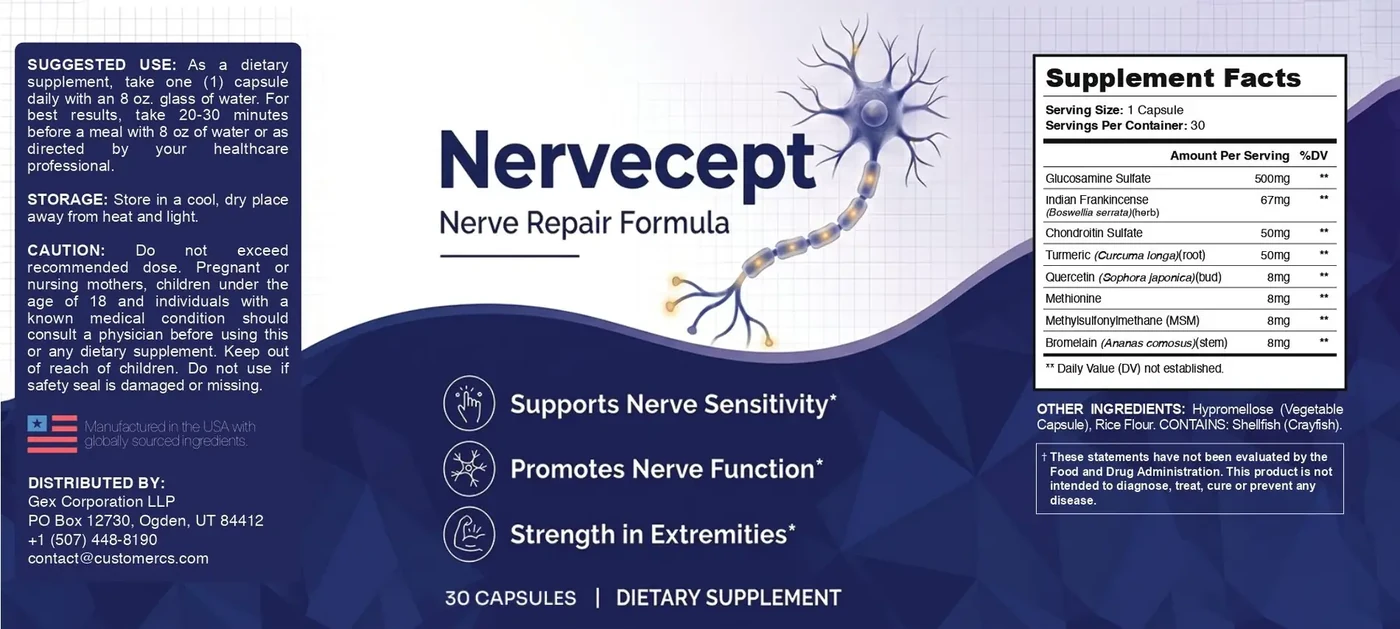
The label reads "Quercetin (Sophora japonica)(bud)". Sophora japonica is the Japanese pagoda tree. Its dried flower buds are rich in rutin, quercetin bound to a sugar, which makes them a common raw material for commercial quercetin. The label does not give the extraction method or purity.
Label line 502
How much quercetin is in one Nervecept capsule?
One Nervecept capsule lists 8 mg of quercetin. That is line 5 of the 8 lines on the Supplement Facts panel, and about 1.1% of the 699 mg of listed actives.
Glucosamine, at 500 mg, outweighs it about 62 to 1. Quercetin shares the 8 mg amount with methionine, MSM and bromelain. Together those four small lines add up to 32 mg, under 5% of the capsule's actives.
No Daily Value exists for quercetin, because it is not a vitamin or mineral.
| Name on the label | Quercetin (Sophora japonica)(bud) |
|---|---|
| What it is | Plant flavonoid from Japanese pagoda tree buds |
| Place on the label | Line 5 of 8 on the Supplement Facts panel |
| Amount per capsule | 8 mg per capsule |
| Share of the 699 mg of actives | 1.1% |
| Amount used in research | 500 mg a day or more (blood pressure trials) |
| Strength of evidence | Mostly lab and small human studies |
| Marketed or traditional use | Plant antioxidant |
| Main caution | Generally well tolerated at food-like amounts; may interact with some drugs. |
Research03
What have studies found about quercetin?
Quercetin's clearest human result is a small drop in blood pressure. A meta-analysis of seven randomized trials with 587 people found systolic pressure fell by about 3 mm Hg and diastolic by about 2.6 mm Hg (Serban et al., quercetin meta-analysis).
The detail that matters most is dose. Those drops were significant only in trials that used 500 mg a day or more. Trials below that amount did not show a clear change, although a direct comparison between the dose groups did not reach significance either (Serban et al., quercetin meta-analysis).
Outside blood pressure, the picture is thin. MSK lists quercetin uses that people ask about, notes that it has not been shown to treat cancer or other diseases, and does not list any nerve use (MSKCC, Quercetin). Most claims about inflammation and cell protection rest on cell and animal studies.
- Best human signal: a few points off blood pressure, at 500 mg a day or more.
- Nerve trials in people, or trials at 8 mg a day: none that we found.
Dose math04
Is 8 mg of quercetin enough to do anything?
Nobody knows, because no trial has tested 8 mg a day. What we can say is that 8 mg is 1.6% of the 500 mg level where blood pressure trials began to show an effect. You would need about 62 capsules to reach 500 mg, and the label allows one.
Two cautions apply. A small amount is not proof of zero effect; the body is not a simple scale. And a larger amount would not prove a nerve benefit either, because the trials measured blood pressure, not nerve function.
Food is a useful yardstick. Diet surveys usually put daily quercetin intake between a few milligrams and a few dozen, depending on onions, apples and tea. So 8 mg sits inside an ordinary diet's range.
| Source | Quercetin | Compared with one capsule |
|---|---|---|
| One Nervecept capsule | 8 mg (label) | Same |
| Blood pressure trials with an effect | 500 mg a day or more (Serban et al., quercetin meta-analysis) | About 62 times more |
| Capers, red onions, kale | Among the richest foods | A normal serving can come close |
| Apples (with skin), berries, black or green tea | Moderate | Several servings can come close |
| Nerve trials in people | Not published | No benchmark exists |
Nerve evidence05
Does quercetin help nerves or neuropathy?
No human study shows that quercetin helps nerves, at 8 mg or at any dose. Quercetin is not a nerve vitamin, and it is not part of any medical guideline for neuropathy.
Guidelines for nerve pain point elsewhere. For painful diabetic neuropathy, the American Academy of Neurology lists four classes of prescription medicine, plus exercise, tai chi or mindfulness for people who prefer non-drug care (AAN, Painful Diabetic Neuropathy 2022). NINDS adds that treatment starts with the cause, since there are more than 100 types of peripheral neuropathy (NINDS, Peripheral Neuropathy).
So the label's "Promotes Nerve Function*" claim cannot be traced to quercetin. See claims vs evidence.

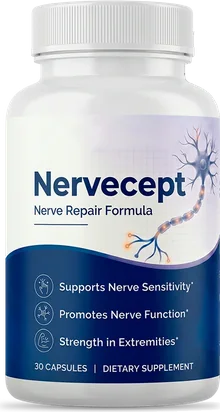
Nervecept: from $49 a bottle30 capsules · 2, 3 or 6 bottles · free US shipping on 3 or 6 · 60-day guarantee
See packsSafety06
Can quercetin interact with medicines?
Yes, quercetin can interact with some medicines. MSK says it may affect drugs that the liver clears with two enzymes, CYP3A4 and CYP2C19, and it describes a man on warfarin whose INR rose and then returned to normal after he stopped quercetin (MSKCC, Quercetin).
INR is the blood test for warfarin; a higher INR means a higher bleeding risk. The case did not involve Nervecept, and we do not know whether 8 mg can shift an INR.
Quercetin is not the only line to watch: glucosamine with chondroitin may also raise INR on warfarin (MSKCC, Glucosamine), and bromelain has a bleeding caution (MSKCC, Bromelain).
| Enzyme or drug | Common examples | What to do |
|---|---|---|
| Warfarin | Coumadin, Jantoven | Ask the INR clinic before starting; expect an extra INR check |
| CYP3A4 drugs | Simvastatin, atorvastatin, amlodipine, cyclosporine, tacrolimus | Ask a pharmacist to check your list |
| CYP2C19 drugs | Clopidogrel, omeprazole, citalopram | Ask a pharmacist to check your list |
Never stop or change a prescribed medicine because you started a supplement. If a pharmacist flags a conflict, the supplement is the one to pause.
Who should ask first07
Who should skip a capsule with quercetin?
People on warfarin or other narrow-margin drugs should ask their prescriber before taking any quercetin product, including Nervecept.
The bigger reason some people should skip Nervecept has nothing to do with quercetin. The capsule's main ingredient, glucosamine, is made from crayfish shells, and the label says "CONTAINS: Shellfish (Crayfish)." Anyone with a shellfish allergy should not take it (FDA, Food Allergies).
- Shellfish allergy: skip the product entirely.
- Warfarin or a transplant drug: ask your prescriber first.
- Pregnant, nursing or under 18: the label says to consult a physician first.
- Surgery coming up: tell the surgical team about every supplement you take (NCCIH, Using Supplements Wisely).
The supplements and nerve medicines guide covers more pairings.
The whole capsule08
Why is quercetin in Nervecept?
The label does not explain why quercetin was added. Our best reading is that it rounds out the formula's anti-inflammatory theme, next to boswellia, turmeric and bromelain, which are all plant extracts sold for inflammation.
At 8 mg, it is a supporting line, not a lead one. If quercetin itself is what you want, a single-ingredient product at a studied amount, chosen with your doctor, is a clearer path than a combination capsule. If you are weighing Nervecept as a whole, the larger lines carry most of the weight: start with the glucosamine page and the full ingredient list.
FAQ09
Nervecept questions people ask
Is the quercetin in Nervecept the same as rutin?
Not quite. Rutin is quercetin bound to a sugar, and Sophora japonica buds are rich in rutin, which is often converted into quercetin. The label lists quercetin, so the 8 mg should be quercetin itself, but it does not say how it was made.
How many Nervecept capsules would equal a 500 mg quercetin dose?
About 62 capsules. Each one lists 8 mg, and 500 divided by 8 is 62.5. The label allows only one capsule a day, so Nervecept cannot reach the amounts used in blood pressure trials.
Can the quercetin in Nervecept raise my INR on warfarin?
It is possible but unproven at 8 mg. MSK reports a man whose INR rose on quercetin and fell after he stopped (MSKCC, Quercetin). Glucosamine and chondroitin in the same capsule may also raise INR, so ask your INR clinic first.
Does eating onions give as much quercetin as Nervecept?
Often yes. Red onions, capers and kale are among the richest food sources, and a normal serving can supply an amount close to 8 mg. Levels vary with the variety, storage and cooking.
Will Nervecept's quercetin lower my blood pressure?
Probably not in a measurable way. The trials that found a drop of about 3 mm Hg used 500 mg a day or more (Serban et al., quercetin meta-analysis). Keep using any blood pressure medicine as prescribed.
What is Sophora japonica?
It is the Japanese pagoda tree, a large flowering tree native to China. Its dried flower buds are rich in rutin and are a common commercial source of quercetin. The Nervecept label names the bud as the source of its 8 mg.
Who wrote this10
Written and reviewed by
Pages built from the label, the sales page and linked NIH, FDA, CDC, FTC and peer-reviewed sources.
Last updated . Read our editorial standards and how we check reviews. This website is run by a Nervecept licensed U.S. outlet, not by the manufacturer or the distributor. We earn money when you buy through our order links.
Keep reading
More about Nervecept
Nervecept licensed U.S. outlet
Ready to try Nervecept?
Check the shellfish allergen and your medicines first, then pick a pack. Three or six bottles ship free in the US and cost less per bottle, with a 60-day money-back guarantee.
- Secure checkout on the sales page
- 60-day money-back guarantee
- Ships from the U.S.